
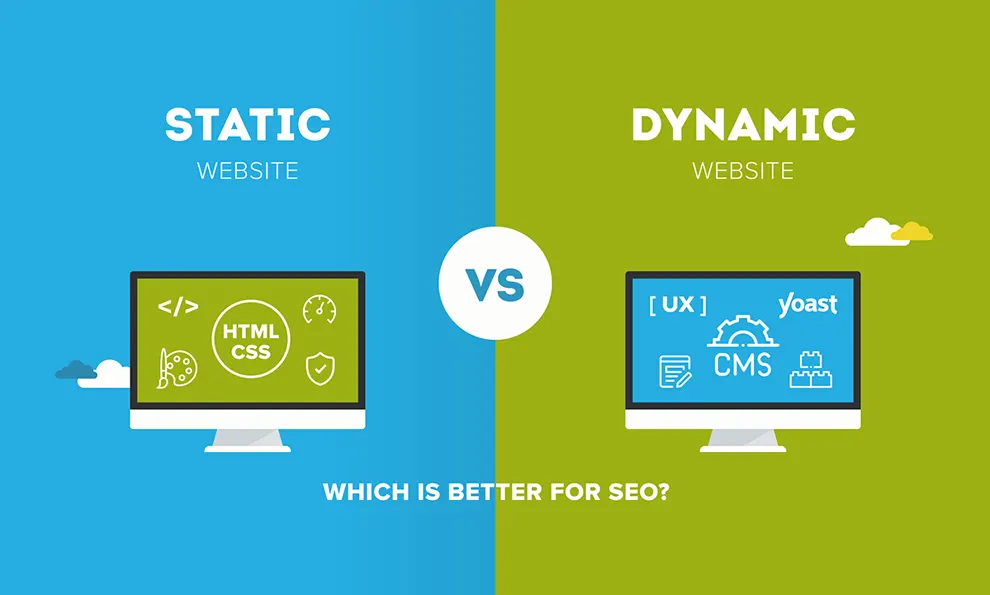
Static and Dynamic Websites have an impact on SEO. A Static website is fixed and displays the same content for every user. A Dynamic website is one that gives different contents according to user interaction. What kind of website is yours? Static or Dynamic? Whatever it is both have pros and cons. Let us discuss to understand Static and Dynamic websites and their impact on your SEO performance. Later decide what type of website is useful for you.
First of all, I am just making sure of the importance of SEO for your website. SEO is all about your website performance and traffic. It is the practice of increasing the quantity and quality of traffic into yours. These various measures can be adopted.
Static and Dynamic Website
Now, come back to the static and dynamic websites. Let us define what is static and dynamic. It refers to the way a page-load to the user. A static page is made up of a series of HTML tags and stored in a server. Whenever a user requests to load that page, it fetches the same static page view. During the earlier time of the internet, all website is static. Dynamic pages are a little complicated. Instead of storing the website pages as HTML files it is managed and maintained using CMSs or Content Management Systems. CMS stores website information on a server and dynamically fetch and displays the content using JavaScript or Php codes for each user when they request. There are both pros and cons for two methods.
Advantages and Disadvantages
A static website is cheap to build and host. But when it comes to maintenance it is difficult and time-consuming. Because, if you want to make a change that affects every page of your website, then you should want to individually open each page and need to edit it. But the dynamic website is initially costly to implement but its maintenance is easy through CMSs. And you can make any changes at any time through CMSs. The above case on a static page can be easily managed in a Dynamic website through a single code. Anybody can manage a CMS website because the CMSs are designed in a way of user interaction.
But static sites load much faster than Dynamic. No time delay to fetch and arrange the pages in front of users. But Dynamic pages take too much time to load to collect the information for users’ interest. And to load CSS and HTML every time when a user request is time-consuming. This can be solved to an extent through a proper optimization process.
Which is better for SEO?
When people try to visit your website, if it takes too much time to load a page, it creates a bad impression. The majority of them tend to leave the website very quickly. So, the loading time is really a matter.
Static websites have better loading speed than dynamic sites. But if your website is large and needs frequent updating, then a static website is not suitable for you. Then you can practice some methods such as; try to reduce your file size always, maintaining the pages that are not needed to update often with HTML, and using a content delivery system or CDN to transfer information like images.
Static websites are easier to crawl. When Google bots comb through the internet, they find static pages of your website easily. And there is more chance to get index all the pages of the site. But the dynamic pages of the site slow down the bolts and they crawl very few numbers of pages and they may not be getting indexed. So static pages are great to get indexed firstly.
Dynamic sites are better for integrating with keywords. Because it is easy to update, you can often change your keyword strategy. After long research, if you find a new keyword, then you can include that keyword on every page of your website. But it is not possible on static pages.
Dynamic websites can be built a mobile-friendly website each time when a user visits. Most of the CMSs built websites mobile-friendly by default. No need to put extra effort into this. But to make a mobile-friendly static website, you have to add additional code to make your website responsive.
Now, you can easily re-optimize your website whether it is static or dynamic for its better SEO performance. Always you can maintain some static pages by staying on a dynamic website to boost your presence online. Please read the previous blog post on How Web Design Affects SEO to get more details.
